Masters of Melee: Klingon Fury Precon Upgrade Guide
A warrior's brew.

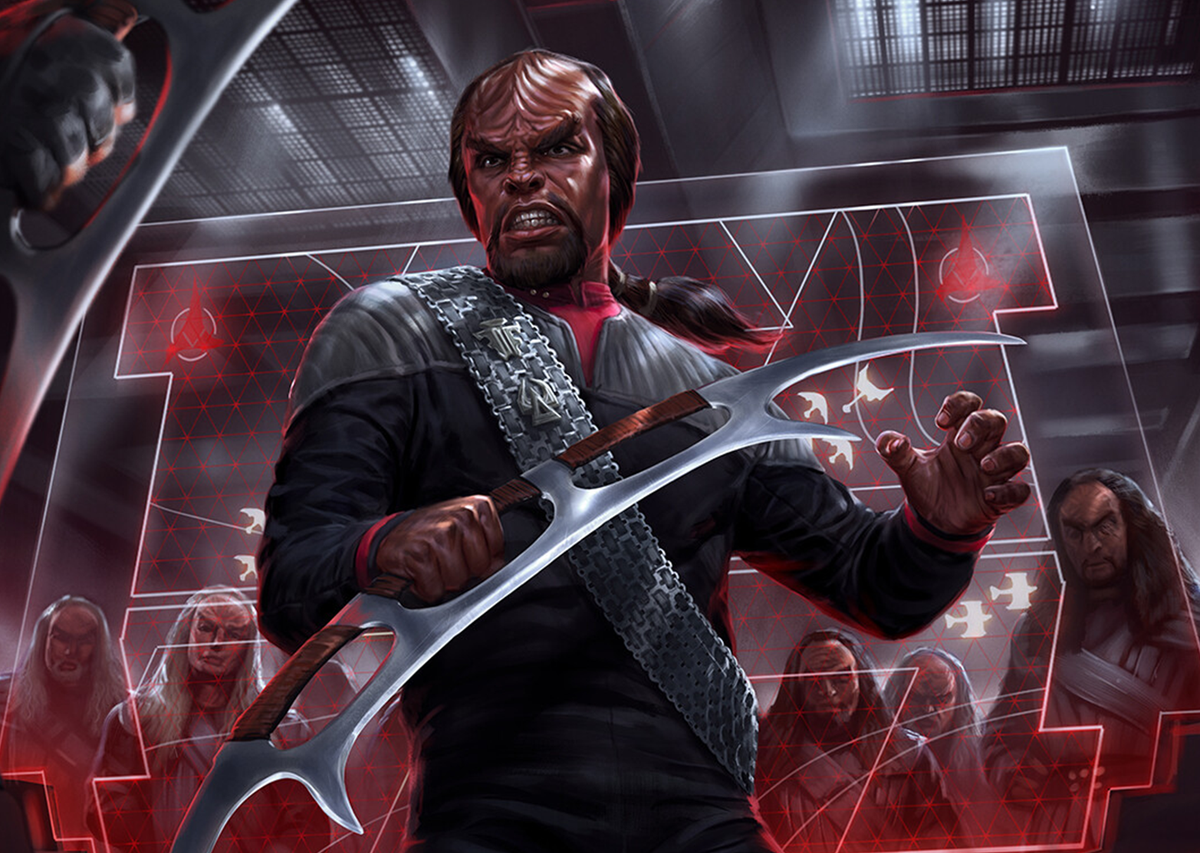
The white-black-red (Mardu) color combination has some amazing commanders and archetypes built around combat steps and combat damage. The Klingon Fury precon introduces a new theme that Wizards started to lean into earlier this year; melee. Titania, Proud Pummeler, from the Marvel Super Heroes Commander set, is unique in its ability to give to your entire board melee in any deck playing red. Now, Wizards released an entire deck built around the strategy of attacking all available opponents every attack step for maximum value—and maximum pain.
The Klingon Way
This preconstructed deck comes with the following items:
- 1 Ready-to-play 100-card Commander deck
- 1 Traditional foil face commander with borderless art
- 99 Non-foil cards, including 32 new-to-Magic cards
- 10 Non-foil double-sided tokens
- 1 Reference card
- 1 Deck box
The official commander, and the one we'll be sticking with for this upgrade, is the Federation's own Commander Worf.

Worf, Defiant Commander is a five-drop commander that creates a 2/1 Klingon Warrior token with haste when he enters. His battlefront mechanic rewards you for attacking as many opponents as possible, and triggers whenever you attack (this will be important later). For each opponent you attack, you get an impulse draw that lasts until the end of your next turn, so you have plenty of time to play those two lands you exiled, or cast multiple spells.

The backup commander, Kor, Cause of Vengeance, is one mana cheaper and still gives you card advantage if you're willing to pay a price. He has an attack trigger that allows you to sacrifice a creature, and if you do, you draw a card, then Klingons and Warriors you control get +2/+2 until end of turn. The deck comes with several cards to give you extra combats, so triggering this a second or third time is very appealing, as stacking up the buffs on your team makes them even harder to defend against. Speaking of stacking buffs, creatures that are both Klingon and Warrior don't receive the buff twice from a single trigger; they still just receive +2/+2.
First Blood
This deck's gameplan is simple; attack early, attack often, and don't stop attacking.


These new cards give you additional payoffs for attacking as many opponents as you can in your combat step. Martok, Hero of the Empire distributes permanent buffs in the form of +1/+1 counters for each opponent you attacked to different creatures you control. It's not the most powerful attack pump effect, but accruing counters will help snowball your threats into larger ones.
Galvanizing Tenor has menace, making him harder to block, and when he attacks he can goad creatures equal to the number of opponents you attacked. The goaded creatures can belong to any player, not just the player being attacked. Since this deck benefits from having more opponents to attack every turn, it may start to struggle if it comes down to a one-on-one duel, so you should use this goad effect strategically to weaken the stronger players.
Korok, Liberated Rage in essence gives your whole team melee when he attacks. That should ideally be a +3/+3 pump effect, and since all but one of the creatures in this deck have at least 2 power or more, that makes your weakest creature have 5 power. Most decks can't defend against that with profitable blocks and you can clear out their weaker blockers.


Every crew needs its redshirts, and in this deck they are 2/1 Klingon Warrior creature tokens.
Rite of Ascension is an impressive card on its own. Four mana isn't cheap, but being able to make three 2/1 tokens each turn is a pretty nice payoff when you can attack all three of your opponents.
Sins of the Father and Glory to the Empire! are more expensive and a little more slow, but bring other benefits. Still, the most important part of both of these cards is that they generate more attackers. Glory to the Empire!'s six mana casting cost is steep, but worth it, because it grants all of your creatures melee. Unlike most creature keywords—like flying, haste, double strike, lifelink—multiple instances of melee stack, meaning a creature that has melee who is granted another instance ends up getting +2/+2 per opponent attacked.


This trio of enchantments enhances your ability to attack, and each one costs just three mana. Warleader's Call is a great reprint that gives your creatures +1/+1 and deals 1 damage to each opponent when a creature you control enters, a peanut butter and chocolate-style combination of Glorious Anthem and Impact Tremors that works especially well with your 2/1 Klingon Warrior tokens. Shared Animosity scales better when you have more creatures in play, although it only enhances your creatures' power so it may be a one-way trip for your brave Klingons attackers.
The one that's effective earliest and in more situations is Duelist's Heritage. On first blush, it just gives double strike to one of your attacking creatures, which often just tells your opponents which creature to block. What I missed at first, when I first read this card years ago, is that it triggers when any creature attacks anyone. That means if your opponents are attacking each other, maybe to benefit from their own combat damage triggers, you can give that creature double-strike to make it even more difficult to block, and more devastating to let through. You can politick with your opponents using Duelist's Heritage and offer them a way to attack your opponents that might not have otherwise been feasible.


Once you're in a good position for attacks, why not do it again? And again? Extra combat cards are incredibly synergistic in this deck. Your "until end of turn" buffs remain on the second trip through the combat phase, and your "whenever you attack" triggers will trigger an additional time.
Prepare for Ramming Speed


The first thing that came to mind after seeing a Mardu deck with so many attack triggers was Isshin, Two Heavens as One. With Isshin and Worf on the battlefield, you'll exile two cards per opponent you attacked. Galvanizing Tenor can goad six creatures if you attack all three of your opponents, and much more. At three mana, this card is an easy decision to include as a trigger doubler.
Titania, Proud Pummeler was a card I mentioned earlier. She's a cheaper version of Adriana, Captain of the Guard and only requires one red pip of mana to cast. Melee is important in this deck for two reasons: it triggers twice with Isshin in play, and it triggers on each combat step, so when you cast an extra combat spell your creatures will get another buff from Titania.
Finally, Ankle Shanker makes all of your attacks painless—for you. First strike and deathtouch are a forbidden combo of keywords in Magic. Only nine creature cards in all of Magic have both of them at the same time. Most of the time, blocking and killing a creature with first strike and deathtouch is futile, but if an opponent tries it, they either need to have first strike or double strike, or they need to block with a number of blockers greater than your creature's power if they want to deal any combat damage to your first-striking deathtouch attackers. You distribute combat damage after blockers are declared, and you only need to distribute one damage to each blocking creature to make sure they die before they get a chance to hit back. That means you'll take out their most powerful blockers first before the surviving one deals damage to your attacker. Ankle Shanker is a bit of a lightning rod, so he may not last on the battlefield for long, but just one attack with the Shanker can let you push through a lot of damage, or take out a lot of blockers while keeping your attackers alive.
Klingons Do Not Procrastinate


One problem with attacking every turn is the part of the game where your opponents get to attack back. To prepare for that unfortunate reality, Reconnaissance is a one mana pseudo-vigilance card that can also save your attackers that get blocked by bigger foes. The new printing's reminder text explains the vigilance "trick" that enables you to untap your creature after damage is dealt.
While Kazuul, Tyrant of the Cliffs doesn't stop your opponents from attacking, it charges them a toll; either pay three mana, or you can create a 3/3 Ogre creature token. This triggers once per creature attacking you, and just like most of the deck, having Isshin out means it triggers twice, meaning they need to pay six mana, or three mana and let you make one 3/3, or zero mana and let you make two 3/3s, for each creature attacking you.
Getting the Edge


These two cards from Magic's first spaceborne set, Edge of Eternities, give you a lot of potential for card advantage in a color combination that usually needs all the card advantage it can get. Elegy Acolyte is one of the few cards that doesn't double-trigger with Isshin out, but for each opponent you deal combat damage to, you draw a card and lose a life. There's a secondary ability that shouldn't be forgotten, and synergizes with the Klingons' dive in head-first mentality; in your end step, if a nonland permanent you control left the battlefield (or was warped, which none of the cards in this deck can do), you make a 2/2 Robot creature token. This is a fair exchange; if you have to send one brave Klingon Warrior token to his death against an opponent with creatures that outmatch yours, in return you get an untapped 2/2 Robot at your end step.
Long-Range Sensor is a great way to use discover to spin into more value. Discover 4 in particular is great in this deck because there are 18 three-drops and 13 four-drops. It just happens to be the casting cost of most of your key cards. Keep in mind it triggers for each opponent attacked, so a single attack against three opponents puts three charge counters on Long-Range Sensor.
Perhaps Today is a Good Day to Die
Not every would-be warrior is cut out for battle. Here are the 10 least-worthy cards to cut to make space for this deck's upgrades:
Too slow: Cha'DIch Investigator, Alexander, Ship's Fool, Chancellor Gorkon. For their casting cost and underwhelming performance, these are just not worth inclusion
Too weak: I.K.S. Negh'Var, Imperial Flagship, K't'inga-Class Battle Cruiser, Ambassador K'Ehleyr. Though it's a shame to deprive the Klingons of their classic space-faring vessels, tapping your creatures who should be attacking doesn't seem like a good idea, which would be required for fully stationing your spacecraft. Ambassador K'Ehleyr's ability is too generous, and the pump effect is too weak in a deck that doesn't make more use of +1/+1 counters with effects like proliferation.
Too distracted: Pest Control, Concerted Effort, Koloth, Tribble Hunter, Curzon Dax, Bound by Blood. The payoff for these last four cards is too limited and conditional for our main strategy: go for the face.
You Are Worthy
Here's a full gallery of the cards to add to Klingon Fury


Now Prove It
Here's the full upgraded decklist ready to play:
Practice your bat'leth technique in our full-table Playtester, or show off your melee skills in our Multiplayer lobbies!
Join our Discord server and have a chat with us about your favorite new brew!
EDHLAB maintains a strict policy against the use of generative AI in the production of creative media. All blog articles and images hosted by EDHLAB are made without the use of generative AI.