Understanding the Commander Bracket System
From the basics to the unwritten rules, here's what to expect when using Commander brackets in your games.

As someone who played Commander both before and after the bracket system was introduced, the format feels more fun and inviting now than ever before, and the Brackets system is a big part of that.
The Commander Brackets system helps you build your deck with intention, rather than an arbitrary idea of how powerful your deck is or how fast it can win, and find well-balanced games even among strangers.
Bracket Definitions
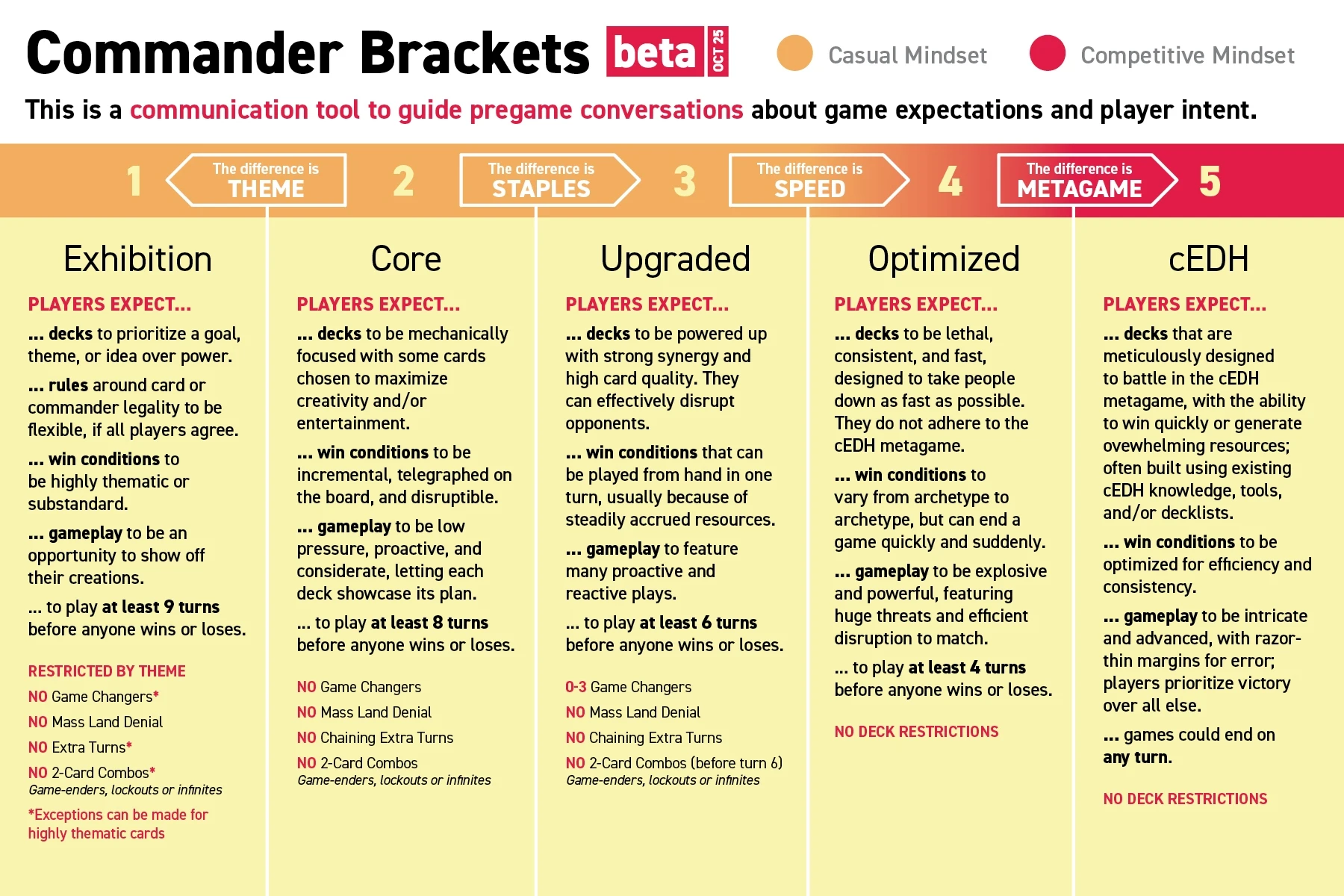
This infographic puts all the basic information about brackets in one image. For greater depth and detail, here's the accompanying article on Wizards' official website.
Defining Terms
Game Changers are cards from the Game Changers list, a curated "soft" banlist maintained by the Commander Format Panel. Cards on the Game Changer list cannot be played at Bracket 1 or 2. Bracket 3 allows for three Game Changers to be played, but they are not a requirement.
Mass Land Denial can be several things. The classic example of a mass land denial card is Armageddon. This is the lowest casting cost card that destroys all lands in play. This can swing the game in favor of one player — usually the person casting it — and set everyone else back to a point from which they'll never recover. The reason the infographic says "Land Denial" and not "Land Destruction" is because several cards accomplish the same goal without destroying any lands. Back to Basics is a card that makes non-basic lands never untap, freezing decks with lots of nonbasic lands in place until they can play enough new lands and find enchantment removal in order to continue playing the game. Winter Orb is another example of this kind of effect. Mass land denial cards are only allowed in Brackets 4 and 5.
Extra Turns are fairly simple: these are cards that instruct you to take an extra turn. "Chaining Extra Turns" means any way to repeatedly play extra turn spells, which monopolizes game time without necessarily ending the game.
Combos are a combination of cards that, when played together, either end the game or lock other players out from playing the game. The Commander Bracket system defines combos by how many cards are required to accomplish the combo, but this is a contested topic that I will cover in a future article.
Differentiating the Brackets
Bracket 1
You're here to play thematic games that tell flavorful stories (or funny jokes) with your cards. Winning is not even really the point, but your deck should have a way to interact and win on at least a basic level.
Consider asking the group just how fast their decks can be. One mid- or low-power Bracket 2 deck can completely run over a Bracket 1 pod, making the game unfun for the person who brought their "Knights in Shining Armor" deck full of knights with little to no synergy and variations of plate armor and knight-themed equipment.
Bracket 2
You're playing to win, but you're doing it with the goal of a longer game where everyone has the time to develop their board and try to execute their plan. The game should last at least around eight turns.
Three-card combos are technically legal in this bracket but are barely seen. A game-winning combo (or lockout) in a Bracket 2 deck should be something involving several high casting cost cards. Mass land denial is not permitted.
The power level of a Bracket 2 deck can still vary significantly. Most precons are technically Bracket 2 but are mildly synergistic at best. Custom Bracket 2 decks can be very finely-tuned around one single gameplan and might overrun the table if left unchecked. Most win conditions use creatures and combat damage, but you will also find spellslinger decks, aristocrats strategies, and alternate win condition decks like mill.
Bracket 3
You're really playing to win, but there are ground rules: no early combo wins or lockouts and no mass land denial. You can play up to three cards from the Game Changer list in your deck. The game should last at least around six turns.
The gloves start to come off off in this bracket. Turn three or four boardstates can either be a few lands and a couple of creatures, or an explosion of value engines, depending on variance and how well a deck is constructed. As long as they're following the rules of the bracket, everything's fair game.
Things to watch out for are people incorrectly playing mana denial cards like Winter Orb, Back to Basics, and Wave of Vitriol, and decks that run a fair combo but are built to draw into it quickly or tutor the combo pieces very early. When a player accidentally breaks the rules of the bracket you're playing in, kindly remind them of said rules and offer to let them set the illegal card aside and draw a new one instead.
Bracket 4
You're playing a fully-optimized deck but it's not top-tier. Bracket 4 decks might have an outside chance of winning on the first few turns, but it shouldn't be consistent. Other than that, anything goes!
The best way to ensure fair and fun games in Bracket 4 is being familiar with Bracket 5. If you can recognize which commanders and which strategies are Bracket 5-tier, then you can avoid some feel-bad games against decks that are tuned to a higher level of performance than yours.
As one example, Godo, Bandit Warlord is a fringe Bracket 5 deck that, when built competitively, wouldn't be appropriate in Bracket 4 because of how likely it is to win on turn two or three if not interacted with. However, an Aurelia, the Warleader deck that tries to win with similar combo lines is fine because it's a much less-effective option that wins on turn four or five in the best-case scenario.
Bracket 5
You're playing the best of the best. This is competitive Commander, or cEDH. Fast decks can win on their first turn with varying degrees of consistency, so having free interaction in the form of cards like Force of Will in the pod is key.
To get started in Bracket 5, much like trying to break into competitive Modern or Legacy, you must use an established decklist you can find online, often from tournament results found on EDHTop16. Start with a deck that has cards and play patterns that are familiar to you. If you're a blue player, you have a lot of options.
Once you get some games in, look to some of the top players in the cEDH community for more advice on playing and deckbuilding. Sam Black has an excellent podcast mostly about cEDH called Sam's Table, ComedIan runs a YouTube channel where he talks about tournament results and his own decks, and Lemora's Cards offers both beginner's guide videos and expert-level breakdowns of the current metagame as it evolves, and often calls out new decks and trends before they hit the cEDH meta at large.
Using playtest cards, also known as proxies, is the only way to play in this bracket on a budget. Many cards on the Reserved List are absolute necessities, and there simply aren't enough printed copies of those cards for all the people currently playing cEDH, Legacy, and Vintage, and all the new players wanting to join in.
Brackets Are a Matchmaking Tool
Brackets are the starting point for my deckbuilding process, and picking a bracket is the first question I ask before starting a game at a table of friends or strangers. Not every game is perfectly balanced and the Brackets system itself is still in beta, but the net effect it's had on my own experience playing Commander has been incredibly positive.
Trying out the Brackets system is a great idea to help balance out home games with your playgroup. You'll also find building for the Brackets system important for playing at game stores or playing online, where nearly every game has a bracket pre-selected before players decide to join in.
Come back later this week for my next article covering some controversies and hot takes about the Commander Brackets system!
EDHLAB maintains a strict policy against the use of generative AI in the production of creative media. All blog articles and images hosted by EDHLAB are made without the use of generative AI.