Out of the Legendarium: The Hobbit Main Set Review
A wizard is never late, nor is he early. He arrives precisely when he means to.


With the entirety of The Hobbit finally available on the official Wizards of the Coast Card Gallery, a full set review is long overdue. While I had fun taking an unexpected shortcut with Mystery Booster Commander, I’ve been excited to review the brand-new Magic cards from the latest Middle-earth set. I’ll be going over my top cards for all five individual colors, the multicolor cards, and the colorless ones in this article, so expect a hearty meal. With the table set and the guests invited, it’s time to jump head-first into an unexpected party!
White
Belladonna Took

We’ve only just begun, and already the first card is up for a nomination for my top-priority pick. Belladonna Took is an absolute banger of a card and an excellent fixer for most flavors of white deck; caring about tokens is a hallmark effect in white, and having three distinct payoffs that each function in multiple varieties of deck — or which can all pay off in a deck for which she's the commander — is a hard standard to beat. Gaining one extra life per turn may not be much, nor drawing one card per turn. Add in a blanket +1/+1 counter on each creature you control, though, and this creature starts cooking. Triggering all three modes every single turn is a tough feat, but that’s the kind of rapid value accrual that transforms a solid engine into a fast-moving clock.
Gleaming Splendor

And for the card almost everybody else is buzzing about, we have Smothering Tithe at home. For once that’s a good thing, because Gleaming Splendor lives in a penthouse with a view of the Empire State Building. For two mana, a Treasure token on every opponent’s second draw is potent, and the potential to force players to draw with the activated ability is not only good to forcibly gain Treasures, but also a potential win condition provided you can get access to infinite mana. Gleaming Splendor is to Smothering Tithe as Magic Johnson is to Cristiano Ronaldo. Both are outstanding performers in their respective lanes, but they play very different games. The four-mana enchantment is oppressive and constant with a heavy thumb on the resource scale, whereas the new enchantment comes out quicker and has additional utility, but a significantly lower ceiling.
Iron Hills Blacksmith

I’m much more enthusiastic about Equipment decks now than I was in years past, and part of the reason for that is the advent of so many new and unique ways to strategize within the theme. Go-wide did not used to be a very strong way to play Equipment decks, but cards like Iron Hills Blacksmith make it look better and better. The Axe token that comes with it may be negligible as a buff, but it’s one more artifact towards Puresteel Paladin’s Metalcraft condition, not to mention it’s another possible permanent to bear hone counters. New to The Hobbit, hone counters are similar to +1/+1 counters, but they only increase power, and they live on Equipment instead. The Blacksmith itself comes with double strike, which is almost always relevant in these types of decks, as combat damage triggers are all too common. All around, this Dwarf does a ton of work for Equipment strategies for just two mana.
Kili the Resourceful

Speaking of Dwarves and Puresteel Paladin, Kili the Resourceful is a Dwarf that does an impression of the Human Knight in almost every possible respect. The storied condition is a slightly more permissive cousin of Metalcraft, and Kili gets one use of each other Puresteel ability per turn, though the free equip only comes after you have an enduring story. Kili is on my list because he’s possibly the best consistency piece that the Dwarf Kindred deck receives from this set. As a Dwarf Fortress enjoyer (I even got the foil Secret Lair) and a lover of short kings, I’ve always wanted a Dwarf deck that wasn’t helmed by Magda, Brazen Outlaw by borderline necessity, and in The Hobbit there are not only several compelling options for a Dwarf commander, but a variety of Dwarf Kindred enablers as well, and Kili is among the best.
Queen of Dale

This one shouldn’t really be a surprise to anybody. Queen of Dale is one of the most hyped cards in the entire set, and while I wouldn’t pay $40 for it, this is easily the strongest generic creature printed in white since Esper Sentinel. The additional draw power is appreciated, but the discard half of the looting effect might be even stronger in the right shell. White is stuffed full of incidental or strong reanimation spells — Sun Titan, Sevinne’s Reclamation, Primary Research, and more. The main component that white struggles with is filling its own graveyard, but the Queen addresses that issue. Even if you don’t play a lot of graveyard synergies, the odds that you’re playing token synergies are probably even higher than the graveyard angle.
Blue
Wizard’s Staff

Kicking blue off is another super-hyped card in Wizard’s Staff. As with other Kindred-specific Equipment, it offers a discounted equip cost to Wizards only at one mana, and three mana for all other equipees. Prowess by itself is strong, especially in 60-card formats, but the trigger-doubling replacement effect is the whole story of this card. Generate twice the amount of mana and pings with Vivi Ornitier, make extra tokens with Murmuring Mystic, or just kill yourself blazingly fast with Dark Confidant and a high mana curve. The cardboard is your oyster here — there are so many powerful Wizard creatures that are popular in this format that I had to dig about 500 of them deep on Scryfall before I started to see creatures I’d never seen before.
The Lord of the Eagles

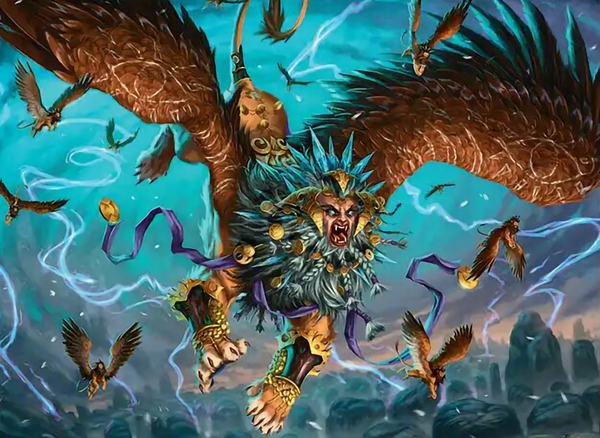
For years, Ghalta, Primal Hunger has been one of the most exemplary stompy green creatures: a big, fat, meaty 12/12 for 12 mana that discounts itself all the way down to just two mana for the measly cost of having big creatures in play which, spoiler warning, green decks are doing anyway. There is a new challenger to Ghalta’s dominance over efficiency, however, in the form of The Lord of the Eagles. In essence, this Bird Noble is like a flying Ghalta — Fl-alta? Eaghalta? — with slightly less power, with the additional benefit that it can be cast at instant speed. Not only is this a powerful higher-end creature for flying-centric strategies, but it’s also a great reward for patience and discipline with mana, as you can hold up lands and rocks for interaction, then deploy the big beautiful bird if you aren’t forced to cast a counterspell.
Bilbo, Thief in the Night

There wouldn’t be a story if it weren’t for Bilbo, Thief in the Night. Well, there would be, as the whole of Lord of the Rings is basically a footnote in Tolkien’s wider legendarium … nerd-tangent aside, it’s tough to compete with two-drop commanders to begin with, let alone a discount-effect two-drop commander: see Baral, Chief of Compliance. Bilbo might not be perfectly built for counterspells and card selection, but he is excellent at flexible spellcasting, be it from exile, the graveyard, or top-of-the-library. On top of that, he allows you to cast instants, sorceries, and artifacts from your graveyard with that discount. While you’ll lose access to the instants and sorceries when they get exiled, repeated abuse of self-sacrifice artifacts like Mishra’s Bauble, Vexing Bauble, Mind Stone, or even Lotus Petal is an avenue ripe for the taking.
Uncover the Moon-Letters

On the topic of enhanced spellcasting, Uncover the Moon-Letters is an excellent card selection tool, and it also works great with Bilbo, Thief in the Night. Far removed we are from the days of Whirlwind of Thought and Vedalken Archmage; now, spellcasting-enabler permanents are drawing multiple cards per cast, and discarding is hardly a downside when there are plenty of ways to get spells back from the graveyard, or even spells that can be cast post-discard via flashback, mayhem, or madness. Just be mindful that Uncover the Moon-Letters works with the amount of mana spent, not the mana value of the permanent itself.
Great Gilded Boat

Though Great Gilded Boat is not as efficient or easy to trigger as Queen of Dale, its recruit ability is still valuable for artifact decks. Emry, Lurker in the Loch is one of the most-played creatures and reliable recursion sources in artifact decks including blue, after all. There are also some cute synergies for incidental token generation in blue because of spells like Moonlit Meditation or Mystic Reflection. For a 4/4 creature, a crew cost of two is an acceptable rate if you’re in need of some combat damage triggers. Lastly, for the real ones out there, mono-blue vehicles that slot into The Omenkeel are literally always welcomed.
Black
Along the Crooked Way

There is something of an occasional trend in enchantment design in modern Magic cards that I find interesting, and Along the Crooked Way is a good example of it. This enchantment is functionally modal; it does a particular action a single time, like a sorcery effect, then has a static ability that pays off future instances of that same sorcery effect. In more specific terms, Along the Crooked Way is a one-time recursion spell that also grows your Army token (or gives you one, if you didn’t have it) every time you recur something out of your graveyard. Primary Research is another example of an enchantment from earlier this year that has a similar design; though the main difference here is that Along the Crooked Way also has a scary keyword-granting activated ability that can act as a win condition in the right situation. This card reads like a silent workhorse piece to me — it’ll accrue lots of value and receive none of the credit.
Head of the Hunt

I sometimes forget that Wizards actually prints good hate piece cards that genuinely disrupt your opponents’ game plans, and not just parasitic abilities that give you a small benefit when an opponent takes game actions. This new card, however, manages to do both. Head of the Hunt is a new Rest in Peace on-a-stick that exiles creatures when they die, and when creatures get exiled from this ability, you get a 2/2 Wolf for each creature that died this way. This is an important distinction, as it pushes Head of the Hunt over the edge from slightly-more-valuable hate card to flexible utility creature. You can play this offensively to shut off your opponents’ dying-based strategies proactively, or you can resolve an asymmetric board wipe (or protect your creatures some other way) with Head of the Hunt on board. You can even flash it in during a block-heavy combat step you’re not involved in to reap the benefits from your opponents’ quarrels.
Supper for Spiders

In a vein similar to graveyard hate, Supper for Spiders reads, at first glance, like a class of cards I like to call “optimistic bombs.” Plenty of these cards get printed all the time — they’re cool, unique, or powerful-sounding spells sporting an affordable casting cost, and often a low price tag too. In practice, however, these spells often end up being too conditional or too inefficient even for cheap and fall out of favor. I predict that Supper for Spiders will not follow this trajectory, however. It’s easy to fall into the trap of wanting to cast this after someone resolved a Wrath of God that took out a bunch of juicy targets, but the best way to think of this spell is like a removal-exclusive kicker cost. For two additional mana, you can Doom Blade a Consecrated Sphinx and receive a slightly-more-resilient artifact-only version of the Sphinx. Four mana for a ConSphinx is somewhere near the ceiling, but considering just how many valuable non-commander creatures are running around in the format these days, I think it’s a great consideration.
The Master of Lake-town

If you’re a sick freak who enjoys playing Mill decks, congratulations! You now have a Mindcrank in the command zone in the form of The Master of Lake-town. I don’t actually believe that this is better than most existing Mill commanders, but this Human Advisor does act as a solid enhancer for strategies that want to dump cards from the library into the graveyard. If you’ve ever played K’rrik, Son of Yawgmoth, then you know how easily black twists life-loss effects that sound painful into powerful benefits. Now you can full-send a Black Market Connections trigger and mill six cards while you’re at it — seems pretty good to me.
The Sackville-Bagginses

Continuing the trend of the Middle-earth setting giving rise to some of the juiciest new token synergy pieces in white-and-black-inclusive decks, The Sackville-Bagginses are here in all of their greedy, vindictive glory. This creature is quite the foil to Belladonna Took, doing nearly the exact opposite. These foul hobbitses filch any artifact or creature they can get their hands on in exchange for a card and a Treasure, which is significant; a permanent-based, slightly weaker Deadly Dispute is ripe for abuse via reanimation loops and repeated recursion strategies often seen in black. A single-opponent life drain effect per sacrificed token may not be as powerful as the potent Mirkwood Bats, but for half the mana cost, these horrid Halflings still hurt.
Red
Balin, Loremaster

Balin, Loremaster, close advisor to Thorin Oakenshield and eventual Lord of Moria, is a curiously high-potential, high-velocity creature. At five mana, he likely won’t see much play in the upper echelons of Bracket 4 and beyond, but with a little tuning and an enduring story to set the stage, Balin can easily churn through 15, even 20 cards in a turn with spells like Reckless Crew or, if Balin is in the 99 of your red-white Dwarf Kindred brew, An Unexpected Party. Even with Dwarven Reinforcements, depending on how full your hand is as you cast it, Balin is still capable of doming each opponent for over ten damage. I’m really glad to see the Dwarf creature type finally getting some real substance in terms of creatures in The Hobbit, and Balin is one of the best.
Dwarven Mauler

Another addition to the ranks of potent Dwarf creatures, Dwarven Mauler is unassuming at one mana for a 2/1. While not quite at the power level of Fervent Champion, this Dwarf Warrior is almost as efficient in terms of cost reduction, and for the long list of Equipment that can attach to the Mauler for free — including some of the best equipment in the entire format — this is a huge benefit. For equipment that cost one or two mana, you can curve cleanly into a free equip on turn two, and for cards like Sword of the Animist, Bloodforged Battle-Axe, or the connoisseur’s choice of Dowsing Dagger, this is a crazy-powerful two-turn sequence that sets you up for success quite handily.
Getaway Barrel

Getaway Barrel is the kind of card that just makes me happy to play Magic. It might not be the strongest or fastest ability, but it’s funny, flavorful, and might just win the game on occasion. Commanders that love to sacrifice artifacts like Mica, Reader of Ruins, Ragost, Deft Gastronaut, or the OG Daretti, Scrap Savant are more than happy to toss this artifact in the bin for some value. If you happen to slap down a huge creature in the process, well, all the better!
Last Light of Durin’s Day

If Avatar: The Last Airbender taught me anything about Magic cards, it’s that cumulative-counter permanents that need several turns to turn on tend to be overhyped. Last Light of Durin’s Day may appear to be in this category, but there are two key factors here. First, as a support card for an expensive creature type that exists primarily in red, ramping for Mountains is already something that you want to do as often as possible. Second, the spell has mountaincycling, meaning that it can provide additional utility in an early hand if you need extra lands or better fixing in multicolor decks. In other words, the opportunity cost to include this spell in a deck with at least a few Dragons in it is very low, and the ceiling for potential benefits is as high as the best Dragon you can include in your deck.
Smaug the Magnificent

It should come as no surprise that the infamous Smaug appears in multiple cards across The Hobbit and its related products, and in the case of Smaug the Magnificent, that he is a powerful creature indeed. A four-mana flying creature with four power and haste is already a respectable rate, and with a high-potential attack trigger that deals damage equal to the number of Treasures you control to any target, this Smaug is already a proactive threat with plenty of flexibility. As if that wasn’t enough, though, Smaug also produces a Treasure token on each of your upkeeps — just make sure he doesn’t catch you stealing.
Green
Bejeweled Warg

Value two-drop creatures that need to connect for combat damage are not exactly a hot commodity in the Commander format, where removal and boardwipes are common and opportunities for free attacks tend to dry up quickly. Bejeweled Warg may be an exception to that trend, however; with three power and trample, it should be able to find an opening for damage for at least two or three turns, meaning an accumulation of Treasure tokens, and if the board begins to gum up with dorks and blockers, you can always switch to the +1/+1 counters. The Wolf acts as a sort of self-sufficient threat that can increase the pressure either through attacks or through repeated Treasure creation.
Beorn the Fierce

One of the most anticipated cards of the entire set that isn’t just a cringe staple, Beorn the Fierce is a Kindred support piece for the finest creature type known to man: the majestic Bears. Paradoxically, Beorn encourages you to play valuable creatures that are not Bears. This must be some mistake, as the only creatures in a Bear deck are Bears or are those smart enough to befriend the nearest Bear. Regardless, Beorn is straightforward in his gameplan — play Bears, buff Bears, go to combat, give Bears trample, draw more Bears, and maul people to death. I’ve already decided to dust off my Bear Kindred list for some overhauls because of this card. I love when Wizards breathes even a few cards’ worth of life into an archetype in need of some support. This Bear is beautiful enough to make a grown man weep.
Dancing from Dark to Dawn

When The Hobbit was first announced, I was expecting to maybe get a solid Beorn card, perhaps one additional solid Bear, and little else to supplement one of my favorite creature types. Fortunately, I was wrong. Dancing from Dark to Dawn is the epitome of what a five-mana do-nothing enchantment should look like, because it actually does something. If you cast this spell and are still able to make a land drop — ideally more, since you’re in green — then you will have already gotten more value out of this spell than the average cast of Doubling Season. That’s not even the main draw to this spell, though; this enchantment also puts an amount of counters equal to the mana value of each creature spell you cast on another creature. Note that this is the full mana value, so even if you get a discount or cheat to cast your creatures, you’ll still get the full benefit.
Radagast of Rhosgobel

If Gandalf is one of the finest of the Maiar on all of Middle-earth, then Radagast of Rhosgobel must be the chillest. He’s even got a bundle of suspicious leaves draped over his sweet hat. It’s fitting, then, that he allows you to hold up your mana and play reactively; you may cast one creature spell a turn at flash speed, and Radagast discounts that spell by two mana. While not strictly better than Yeva, Nature’s Herald, as she allows you unlimited flash-speed casting of green creatures, this Avatar Wizard comes very close. It’s so hard to beat that sweet discount. And would you look at that — he’s even got a friendly Bear following him around. That counts for plenty in my book.
The Notary Hobbits

If the expanded range of Bear support cards took me by surprise, then The Notary Hobbits practically bowled me over. The effect is unique for this color: The Notary Hobbits creates two token copies of itself when they enter, provided they aren’t a token; they also tap for one colorless mana per Halfling you control. Token copy shenanigans are not exactly a primarily green endeavor outside of the odd Bramble Sovereign and occasional populate trickery, but tapping for a ton of mana certainly is. Without any additional Halflings on the battlefield, each copy of The Notary Hobbits taps for three colorless mana at minimum the turn after they come in. The trouble is that it isn’t exactly easy to get more; there are only nine additional Halflings in mono green, so what’s a hobbit to do? There are many creative ways to get more Halflings in play; Springleaf Parade (which also benefits from the excess mana production), Conjurer’s Closet, and For the Common Good are all good starting points for this deck.
Multicolor
Bard, King of Dale

I have a love-hate relationship with this commander. Bard, King of Dale is a stable creature as a 3/5 for six mana with reach and vigilance, and its abilities to double your draws and double your token production are obviously potent. I enjoy a commander that doesn’t toss its hat into any particular ring, and drawing cards and making tokens are pretty much foundational in blue and white respectively. That being said, this is still Teferi’s Ageless Insight and Anointed Procession stapled together on a stick with a solid statline. It’s about as common as the lowest common denominator gets — you could toss most of a bulk bin in this commander’s 99 and it would still outgrind most other decks in a lower-power game way too easily.
Bolg’s Company

While Universes Beyond has made the mechanical-theme throughline from set to set harder to trace, it presents more clearly from time to time. Rakdos Goblins are a great example: we just had red-black Goblin Kindred in Lorwyn Eclipsed earlier this year, and while there isn’t a perfect alignment of themes between Middle-earth Goblins and Lorwyn ones, Bolg’s Company is a great expression of the ever-present sacrifice theme. Evidently, this isn’t as combo-tastic as a Skirk Prospector — at least, not for free, since you can still do it easily with Thornbite Staff — but it’ll still ramp you very nicely in two colors that struggle for stable ramp in the early game.
Smaug, Wicked Worm

For the old-heads among you who remember a time when Prosper, Tome-Bound was one of the most popular commanders on the block, Smaug, Wicked Worm fills a similar role. I wouldn’t exactly call Prosper’s fall from favor undeserved, but one thing’s for sure — Smaug puts him to shame. For just one extra mana, you get a pseudo-Dockside Extortionist ability when Smaug enters, making an amount of tapped Treasures equal to the number of artifacts your opponents control. On top of that, as opposed to the slow, sustained rebate on mana spent for spells Prosper offered, Smaug brings even more velocity to the deck, allowing you to continuously draw more cards as long as you have the life and Treasures to spare.
Dwalin, Weaponmaster

As I mentioned earlier, hone counters may be one of the coolest mechanics to come out of this set overall, and Dwalin, Weaponmaster is the keystone creature for distribution of those artifact-buffing counters. Whenever the Dwarf Warrior enters or attacks, each Equipment gets a hone counter, and with first strike, Dwalin is a tough attacker for opponents to block, particularly if he’s equipped. Go-wide Equipment decks continue to get stronger, especially after The Hobbit, and Dwalin will certainly show up in quite a few of those lists.
Thorin Oakenshield

The originator of the Quest of Erebor himself, Thorin Oakenshield may seem unimpressive, but this two-drop creature is my personal choice for best new Dwarf Kindred commander of the set. You may argue that Bifur, Melodic Rider or Thorin, King of Durin’s Folk from the Scene Box set are stronger contenders, and though they more clearly care about Dwarves, Thorin Oakenshield has much stronger traits overall. First, a two-mana 3/2 commander with trample can apply pressure earlier than either of the other Dwarves, and secondly, the cheap mana value means that Thorin is resistant to removal at least twice before he’s too expensive to cast, which is much more important than most people tend to believe. Lastly, the blanket ward protection he provides from the easily-achieved enduring story condition is an effective way to keep your wide board of sword-and-board Dwarves and their trusty Equipment insulated against removal.
Thranduil’s Company

I am extremely glad that this Elf has blue in its color identity, as that restricts it from being played in the mono-green and Golgari colors that more commonly host Elf Kindred decks. Thranduil’s Company would be crazy strong in a variety of Elfball lists in those colors; not only is it Exploration on a stick, but it actually rewards you for those additional land drops too. Each Landfall trigger puts two +1/+1 counters on any creature you control, and gives it vigilance to boot. While Elfball decks don’t lean as hard on land-based ramp as other green decks, some brews are still running the likes of Springbloom Druid, Wood Elves, or Farhaven Elf, not to mention any fetchlands available. Thranduil’s Company is highly potent for little investment.
Thranduil, Elvenking

Speaking of throughlines with Lorwyn Eclipsed, Sultai Elves surface once again with Thranduil, the Elvenking. I won’t spend much time discussing him, though, as our new staff writer Jon wrote a full analysis of the best Elves to put in your Thranduil brew, and gives plenty of analysis about the power and potency of Thranduil’s abilities. Go give him a warm welcome to the EDHLAB crew!
Artifacts/Colorless
Glamdring, Foe-hammer

Before I get into why I love this card, I need to disclose that Glamdring, Foe-hammer is not a good card. It falls into a strangely persistent category of Equipment cards which synergize with instants and sorceries, but which almost never appear in Spellslinger decks because of their sorcery-speed limitation and lack of flexibility. That being said, I love this card. That category of Equipment may not be particularly strong, but it’s awesome. On top of that, Glamdring is a spectacularly awesome artifact out of the Tolkien legendarium. Originally wielded by one of the Elven kings of Noldor in the First Age, Glamdring is a sword created with the express purpose of slaying goblinkind, and its violent fulfillment of that purpose created a legacy that endured over 6,000 years. As a huge fan of the lore of Middle-earth, I can’t express enough just how cool it is to see these flavorful executions of my favorite parts of Lord of the Rings.
My Precious

While not nearly as powerful as the OG printing, this portrayal of Isildur’s Bane, the One Ring, is still strong. Village Rites is a solid spell in Aristocrats decks, and tacking one extra mana to its cost is manageable. On top of that, you get access to a “fixed” Whispersilk Cloak that provides the option to equip at the paltry cost of two life. This is a flat-out improvement on the original card which does not play nicely with Voltron stacks of Aura and Equipment. While I don’t think this will see play in conventional Voltron lists, it can show up in Aristocrats decks that can grow big creatures over time to sneak in some extra damage with an unblockability effect. Now, where can I find a progressive-buff mechanic that’s on-theme for the forces of evil in Middle-earth?
Orcrist, Goblin-cleaver

You may be noticing a theme with the artifacts in this set — whether they’re powerful or not, they’re rad as hell. The electric-blue glow of Orcrist, Goblin-cleaver is alluring, but its ability is even better. It costs three mana each to cast and equip this card, which is a steep investment, but a single combat damage trigger — generating a Treasure per creature type you control, chosen on trigger for flexibility — can pay you back in spades with a developed board. The main strength over Three Tree City stems from the ability to abuse multiple combat steps, or even just having double strike. It’s far easier to fire off two or three triggers of Orcrist than it is to get a Three Tree City activation and untap it, and even without the full strength of synergies, generating two or three Treasures per combat before you can set up a big trigger is still plenty worthwhile.
Sting, Bilbo’s Sword

This is the last Equipment to review, I swear! Sting, Bilbo’s Sword is the most unique design of these artifacts. Flash-enabled, auto-equipping Equipment are wonderfully flexible. Sting’s buff gets stronger the more creatures an opponent controls, beautifully utilizing the hone counters The Hobbit introduces and symbolizing the flavor of standing against a massive tide of Goblins. Though situational as a result of its dependency on opposing boardstates, I believe that Sting has plenty of potential and interesting tech available to enhance it even more.
Wrap-up
And with that, we’ve successfully covered all of the main set and Scene Box cards printed in The Hobbit. Keep an eye out the rest of this week for some more fun articles about this awesome set — I think you’ll enjoy what we’ve been cooking up, and to give you a hint, it definitely isn’t second breakfast, but it may satisfy a different kind of craving for The Hobbit!
The Best Way to Play Commander Online
For the easiest way to play Commander online with your friends or meet new opponents on the field of battle, use EDHLAB.gg's Play Online feature!
Join our Discord server and have a chat with us about your favorite new brew!
EDHLAB maintains a strict policy against the use of generative AI in the production of creative media. All blog articles and images hosted by EDHLAB are made without the use of generative AI.