Hybrid Mana in Commander: Aesthetics as Gameplay
I've been on a mission to determine why I feel the way I do about the hybrid mana rule in Commander.


The debate around changing the hybrid mana rule in Commander is settled — at least for now — and after discussing the merits of changing the hybrid mana rule on various social media platforms over the past few months, I finally got to the heart of why I oppose it.
Where the Hybrid Rule Stands Now
For those who weren't keeping up with Magic news, in October 2025 the Commander Format Panel (CFP) announced they were considering changing how hybrid mana works in Commander.
Hybrid currently counts all colors in its casting cost to determine its color identity. The color identity rule is something that exists only in Commander and was created for the format many years ago. From Magic's Comprehensive Rules 903.4:
The color identity of a card is the color or colors of any mana symbols in that card’s mana cost or rules text, plus any colors defined by its characteristic-defining abilities (see rule 604.3) or color indicator (see rule 204).
What Could've Been
Let's consider for a moment what it would mean to allow hybrid cards to be played in decks that could cast it, rather than decks that include all of its colors.
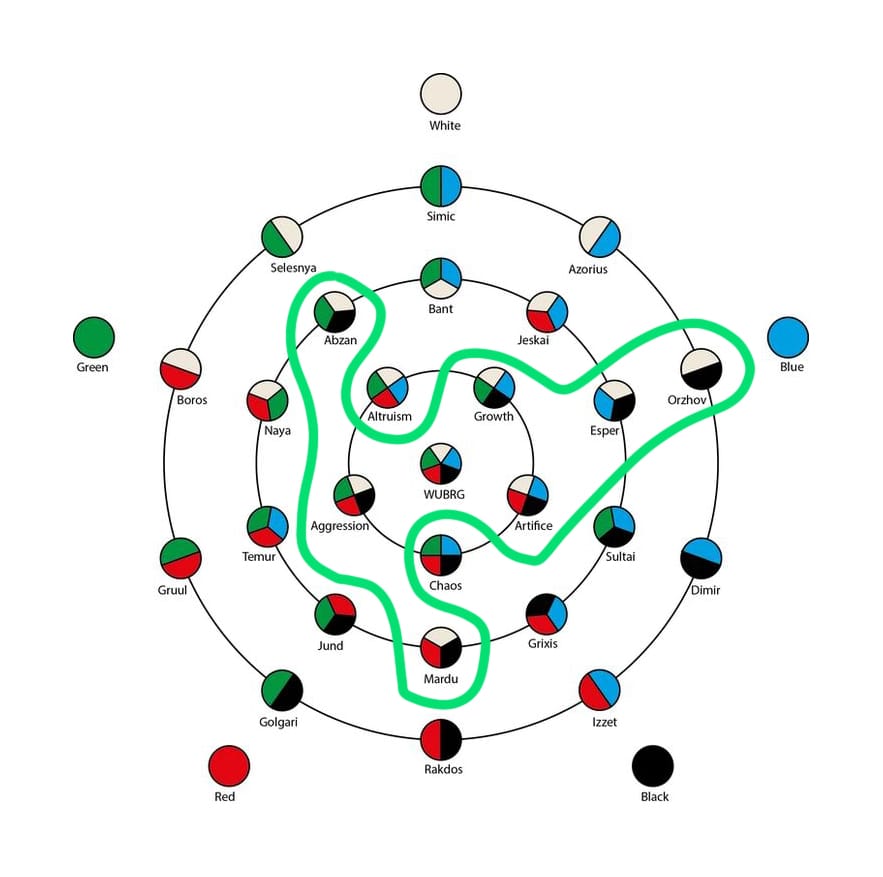
Below is a map of all the color combinations. I outlined all the color combinations that can currently play an Orzhov hybrid card (let's say Afterlife Insurance, since that will come up later).
Here's that same map if the hybrid rule was changed and you could play Afterlife Insurance in any deck with either white or black mana as part of its color identity:
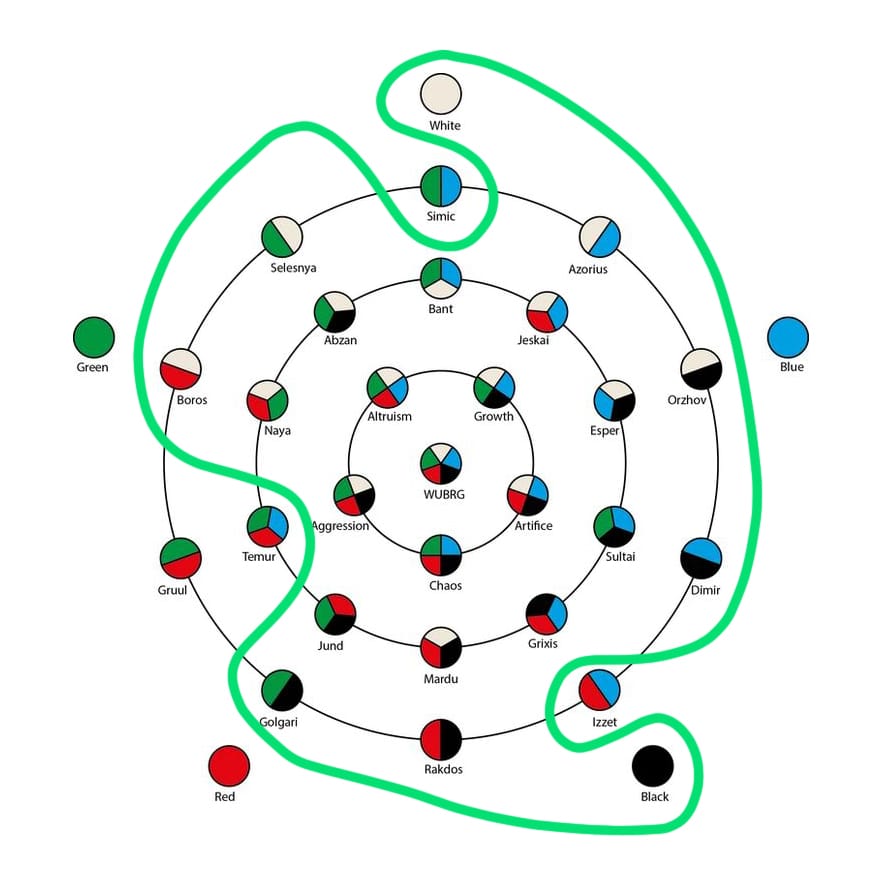
The increase in deck availability is substantial. We go from eight potential color combinations to 24 potential color combinations. Is that a good thing? Is this giving more tools to color combinations that are underpowered, or is this homogenizing the format by letting 75% of decks play Afterlife Insurance? There are good arguments on both sides of this discussion.
Hybrid mana cards are designed to adhere to the color pie limitations of both of its constituent colors. In other words, Magic designers designed Afterlife Insurance such that it could have been either a black card or a white card and it wouldn't break the boundaries of the color pie and the exclusive effects to which each color has access. Hybrid cards frequently bend the color pie in what Mark Rosewater calls "aesthetic bends."
An example of an aesthetic bend was recently addressed on Mark's personal blog, Blogatog. Someone asked if Don & Raph, Hard Science having menace means any new blue creatures can now have menace, and Mark clarified that menace was an aesthetic bend because blue already has access to unblockability. Therefore, from Magic's design perspective, any effect that makes your creature harder to block is something that blue could do. Although they're unlikely to start making tons of mono-blue menace creatures, they will apply it to hybrid-blue creatures as often as they please.
Hero or Menace?
When I first saw J. Jonah Jameson in Magic card form during spoiler season for the Spider-Man set, I appreciated the artistry of the card's design despite my apprehension about a whole Standard-legal set centered around Spider-Man. His card reminds us of Jameson's newspaper's headline, "Spider-Man: Hero or Menace?" It tells a cohesive little story; Jameson creates a menace out of some unsuspecting person and then profits off of their continued actions, whether they're doing good or evil. Every time Spider-Man saves a train from flying off the tracks, Jameson finds a way to spin the story to make Spider-Man into a menace to society, not a hero. It's a satisfying and brilliant use of the Magic game lexicon to tell another franchise's story. I can't help but marvel at it.
"Menace" is a word we use in everyday life. It describes a troublemaker. A menacing presence inspires fear. A menacing message might be an implied threat that causes you concern. Most of the creatures in Magic that have menace meet the aesthetic requirement of being menacing. It is reserved for black and red effects and creatures.
Looking through every multi-colored creature with menace, you'll notice how incredibly careful the Wizards design team is when giving creatures menace. Every single example contains red or black as a casting cost requirement. Every single card except for one:
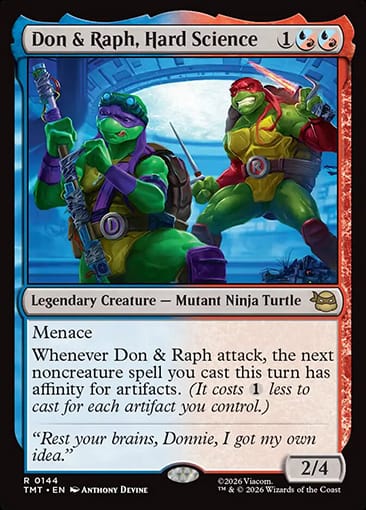
Don & Raph, Hard Science can be cast for either 1UU, 1UR, or 1RR. From a design perspective, this card was designed to be seen as either a blue card or a red card. The affinity for artifact synergy ability fits the bill, but menace stands out. When considered as a mono-blue creature, this is the first mono-blue creature since Ice Age to have menace, before the ability was given its evergreen name.
Sixty-card Magic formats like Standard, Modern, Legacy, as well as 40-card formats like Draft and Cube, don't have a color identity rule. You can — and should — play any color creature you'd like in your Legacy Reanimator list because you won't be tapping mana and casting them anyway; you'll be dumping them in the graveyard and resurrecting them for cheap. Commander is unique in that the colors are in their own corners, stuck with their advantages and their disadvantages.
Color Showdown
Commander isn't just about picking a legendary creature, vehicle, or spacecraft to lead your deck. Your commander's colors limit what cards you can put in your deck in an exclusionary way.
With the current rules, if a card has a color that doesn't match the commander's color identity, you might imagine your commander tossing that card away with a look of disgust. From a flavor and aesthetics perspective, a Giada, Font of Hope deck would never run a card like Murder even if it could. It would, however, run better cards that accomplish the same thing — Path to Exile, Swords to Plowshares, Generous Gift — because of aesthetics. Your creature didn't get murdered, it gave up fighting on the battlefield to retire to a farm. Or you were forcefully given a 3/3 green elephant in exchange for your creature leaving the battle. This creates a ludonarrative — a story created through gameplay. Giada might invoke widespread wrath through cards like Day of Judgment, Planar Cleansing, or Hour of Revelation, but she would never douse the battlefield in a Toxic Deluge, or condemn all creatures to Damnation, or declare a Decree of Pain.
Commander brought out the best in Magic. Magic is not just a fascinating mathematical game with heavy variance that generated concepts like "card advantage" and inspired ground-breaking articles in game theory like Mike Flores' "Who's The Beatdown?" Magic also tells a story, one that is a little more muddled lately with Universes Beyond's additions, but is still doing its best to hold on to the color showdown theme that Magic was founded on.
Since early in Magic's history, skilled deckbuilders saw theme as a hurdle to jump over to achieve victory rather than a part of Magic's ludonarrative to incorporate into their decks. Because Magic as a game is so customizable between and within formats, everyone can enjoy Magic as best suits them and their playgroup.
My Reason
Consider the following game of Commander.
You're playing a Rakdos Mogis, God of Slaughter deck. This commander leans into the "punisher" archetype of deck builds. Does your opponent have no creatures? They take damage. Did they cast a creature? They take damage. Did you cast a creature? That's right, they take damage. Did they draw a card? The nerve! They take damage.
Two players have been eliminated and you're facing off against a Brago, King Eternal deck. The infamous blinkmaster is whittled down to 2 health. One Mogis trigger on his upkeep and he'll be eliminated.
It's your turn. You cast Blasphemous Act to clear his board. Brago has two mana open and a suspicious smile. He casts Afterlife Insurance in response. His creatures all die, but he gets 1/1s in their stead. You pass the turn, he sacrifices one of the tokens on his upkeep, and swings for lethal.
Rakdos Punisher lost to Azorius Blink. Or did it?
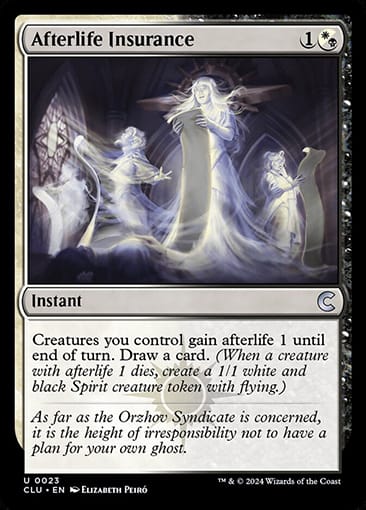
Afterlife Insurance isn't the only way out of that situation. Besides counterspells, Azorius has access to Dawn's Truce, a card that gives your board hexproof and indestructible until end of turn. Clever Concealment phases out your creatures until you next turn. But the card that beat you was Afterlife Insurance. Does it feel like Azorius beat you? Does "afterlife insurance" — the idea of taking out a profane insurance policy against your minion's lives and profiting from their deaths — feel like a purely white effect? To me it doesn't fit white's aesthetic. I would say it's an aesthetic break using the literal meaning of the term aesthetic. White doesn't give you the ability to profit from your creatures' deaths. White saves your creatures. When white brings your creatures back from the graveyard, they're not animated corpses, they're fully restored to life and spared from their fate.
Afterlife Insurance tells a different story, and it's what finally made me realize what feels wrong about casting off-color hybrid spells in Commander: Brago could cast it, but so could a Prossh, Skyraider of Kher deck, which has neither white nor blue. What does Afterlife Insurance feel like when two different decks that share no colors can cast it? It feels basically colorless.
Command of Color

Putting it mildly, Magic's aesthetics are loosely maintained. We're not too far now from seeing Captain Kirk and Mr. Spock battle against Sauron, Sephiroth, and Sonic the Hedgehog. If there was a plot, Magic lost it a long time ago.
Aesthetics are subjective, and what's beautiful to one player may be uninteresting to another. Regardless, there is a ludonarrative running through Magic's mechanics and color pie that keeps games of Magic coherent and fun.
The problem with aesthetic bends is that they add up. They accumulate, and if the CFP changed the hybrid mana rule, color identity would inevitably make itself obsolete, because if Afterlife Insurance can be cast in both an Azorius deck and a Jund deck, what story are Commander's color limitations telling? The ludonarrative is shattered.
Erosion is enabled by erosion. The invocation of the slippery slope fallacy must be done with sufficient evidence because in reality there exist actual slopes that are actually slippery. Magic started its journey into Universes Beyond with a promise of Universes Within equivalents. The ground slipped and gave way, and now we await the arrival of the USS Enterprise to join the ranks of SpongeBob, Dwight from The Office, and Megatron from Transformers. Commander’s rules should be guided by the same slow and steady philosophy that nurtured its exponential growth.
Check out our article on the other big Commander Format Panel announcement, In the EDHLABoratory: Should Rhystic Study Be Banned?
EDHLAB does not support the use of generative AI as a means to produce content. Any articles you read on our website will never incorporate generative AI for written or visual materials.